What Hidden Risks Threaten Cleanroom Integrity Beyond Visible Particulates?
A cleanroom can look immaculate and still fail to protect a sensitive process. Transparent air, polished work surfaces, and a low particle count do not necessarily mean that every contaminant is under control. Effective cleanroom contamination control must also account for airborne molecular chemicals, microbial transfer, electrostatic discharge, and pressure differences that are too subtle to notice without appropriate instruments. These less visible risks can compromise product quality, experimental reproducibility, and the integrity of scientific data even when routine housekeeping appears satisfactory.
The central question is not simply whether a room is clean, but whether its environment is suitable for the particular process taking place inside it. A semiconductor assembly area, a pharmaceutical preparation room, and a university research laboratory may face very different contamination pathways. Understanding those differences helps facilities establish meaningful monitoring programs instead of relying on a single cleanliness indicator.
Can a Cleanroom Be Contaminated Even When No Particles Are Visible?
Yes. Visible cleanliness and environmental control are related, but they are not interchangeable. Many contaminants are too small to see, while others exist as gases, vapors, electrical charges, or biological material that may not be detected by ordinary particle counters.
Consider a workbench that has been wiped until it appears spotless. A cleaning agent may leave a thin chemical film behind. A nearby process may release volatile organic compounds. A technician may introduce microorganisms through a glove or transfer item, while a charged plastic container may attract particles toward a sensitive surface. None of these conditions necessarily produces an obvious visual warning.
This distinction matters because different hazards require different detection methods. An airborne particle counter measures particles within its specified size range; it does not establish the chemical identity of airborne molecules or confirm that a surface is microbiologically acceptable. Similarly, a room pressure reading cannot prove that every work surface is free of residue.
The practical answer is to treat cleanroom integrity as a collection of related control objectives. Particle cleanliness, chemical purity, microbiological control, electrostatic protection, and airflow management should be evaluated according to the risks of the process rather than assumed to be covered by one general cleanliness rating.
Why Do Molecular Contaminants Matter When Particle Counts Are Acceptable?
Molecular contamination is one of the most easily overlooked limitations of conventional cleanroom monitoring. It includes airborne molecular contaminants, often abbreviated as AMCs, and chemical residues deposited on equipment, products, instruments, or work surfaces.
Potential sources include solvents, acids, bases, cleaning products, plastic components, lubricants, adhesives, packaging materials, construction products, and chemicals released by nearby manufacturing operations. Personnel can contribute contaminants through cosmetics, fragrances, skin products, and residues carried on clothing or gloves.
How can invisible chemicals affect sensitive processes?
The effect depends on the chemical species, its concentration, the exposure duration, and the material being processed. In semiconductor manufacturing, certain airborne acids, bases, and organic compounds can affect sensitive surfaces or contribute to defects. In analytical laboratories, trace chemical residues may interfere with sample preparation or produce misleading background signals. In optical systems, deposited films can alter surface performance or reduce transmission.
Pharmaceutical and biotechnology environments also require attention to chemical carryover. Residues from cleaning agents, disinfectants, or process materials may become relevant when they contact product-contact surfaces or interfere with a validated procedure.
A critical distinction is that airborne concentration and surface deposition are not the same measurement. A brief air sample might show an acceptable concentration while a chemical has already accumulated on a vulnerable surface. Conversely, a detectable compound in the room air may not present a meaningful risk to a particular process if the material is insensitive to it and exposure remains within established limits.
Which controls address molecular contamination?
- Source identification: Review chemicals, materials, packaging, cleaning products, and adjacent processes that could release relevant compounds.
- Material compatibility: Assess whether construction materials, seals, tubing, adhesives, and equipment components could emit or transfer unwanted substances.
- Appropriate sampling: Use chemical-specific sampling and analytical methods when risk assessments identify a credible molecular hazard.
- Source capture: Where suitable, use local exhaust or dedicated extraction to prevent contaminants from entering sensitive areas.
- Controlled cleaning: Verify that cleaning methods remove the target residue without introducing a different contaminant.
Air filtration alone does not guarantee molecular control. A high-efficiency particulate air filter is designed primarily to remove particles, not every gaseous contaminant. Gas-phase sorbents or other specialized treatment may be needed when the contaminant chemistry and process requirements justify them.
Can Microorganisms Enter Through Pathways That Particle Monitoring Misses?
Yes. Microbial contamination can be introduced through people, equipment, water, damp surfaces, transfer operations, and contaminated materials. Microorganisms may travel on particles or droplets, but their behavior and significance cannot be inferred from total particle counts alone.
A particle counter does not identify whether a detected particle contains a viable microorganism. It also cannot establish whether an area meets a microbiological acceptance criterion. Microbial monitoring therefore requires methods appropriate to the organism, surface, environment, and intended use.
Personnel and transfer materials are important vectors
People can shed skin fragments, carry microorganisms on garments, and transfer contamination through glove contact. Poorly controlled movement between rooms may spread material from a less controlled area into a more sensitive one. Carts, reusable tools, containers, and packaging can also become transfer pathways when cleaning or disinfection is ineffective.
For example, a technician may follow a correct gowning procedure but then touch a door handle outside the controlled area and immediately handle a critical item. The gown itself may remain intact, yet the contact sequence creates a potential contamination pathway. This illustrates why gowning rules must be supported by behavioral controls and a clear understanding of clean-to-dirty movement.
Why moisture deserves special attention
Standing water, condensation, wet insulation, leaking services, and poorly maintained drains can create conditions that support microbial persistence or growth. Humidity alone does not prove that a room is contaminated, and not every organism responds to moisture in the same way. Nevertheless, persistent dampness should trigger an investigation because it can indicate a building, maintenance, or cleaning problem.
Microbiological control should be proportionate to the process. A laboratory performing routine instrument calibration does not necessarily require the same environmental microbiology program as a facility preparing sterile products. If microbial contamination can directly compromise product safety or a critical experimental result, risk-based environmental monitoring, validated cleaning procedures, and defined response limits become especially important.
Does Electrostatic Discharge Threaten Cleanroom Integrity Without Leaving a Visible Trace?
Electrostatic discharge, or ESD, can cause immediate damage, latent component failures, and unpredictable handling problems. A discharge may be too brief to see or feel, yet it can affect sensitive electronic devices. Static electricity also influences particle behavior by attracting charged particles to surfaces and causing some materials to adhere unexpectedly.
Electrostatic risk is therefore not limited to electronics manufacturing. It can matter wherever sensitive components, precision surfaces, delicate materials, or contamination-sensitive processes are handled.
How does static charge develop?
Charge can accumulate when materials separate after contact, when people walk across flooring, or when objects move, unwind, or slide against one another. Dry environmental conditions can increase charge persistence in some situations, but humidity is not a universal solution. Material properties, grounding, movement, and the design of the entire work area all influence electrostatic behavior.
A plastic tray may appear harmless because it is clean and undamaged. However, if its electrical properties and handling conditions permit charge accumulation, it may attract particles or expose a sensitive electronic component to an ESD event. Replacing it with an arbitrary alternative is not automatically safer: the replacement must also be compatible with contamination, chemical, mechanical, and process requirements.
What does an effective ESD program include?
- Grounding and bonding appropriate to the equipment and operation.
- Verified personnel grounding systems, where required by the applicable ESD control program.
- Suitable work surfaces, flooring, garments, containers, and handling tools.
- Periodic checks of grounding connections and other protective equipment.
- Training that explains how routine movements can generate or transfer charge.
Ionization may be useful where insulating materials cannot be reliably grounded, but it must be selected and maintained for the application. An ionizer does not replace grounding for conductive items, nor does its presence establish that the whole workspace is ESD-safe. Monitoring and verification should follow the site's documented ESD control plan and applicable technical standards.
How Can Small Pressure Differences Allow Contamination to Travel?
Pressure differentials help establish the intended direction of airflow between adjacent spaces. When correctly designed and maintained, they can reduce the movement of unwanted air from less controlled areas into more sensitive environments. The challenge is that a pressure relationship is dynamic: it changes as doors open, fans operate, filters load, and ventilation systems respond to demand.
A room may show a normal pressure reading during a routine inspection but experience a temporary reversal when a door opens or an exhaust system changes state. A single measurement cannot fully describe every transient airflow condition.
Why direction matters more than an isolated number
Positive pressure is often used to protect a cleaner space from surrounding areas, while negative pressure is used in certain containment applications to prevent hazardous material from escaping. These objectives are different. A pressure strategy that protects a product is not automatically appropriate for containing a hazardous process.
The required pressure relationship must follow the room's intended function, the facility design, and applicable safety requirements. Some facilities use cascading pressure zones; others depend on local containment equipment or specialized airflow arrangements. Pressure targets should therefore come from an approved design and risk assessment, not a generic rule applied to every cleanroom.
Consider two adjacent rooms that differ by only a small pressure margin. The reading may appear stable when both doors are closed. If frequent personnel transfers cause simultaneous door openings, however, the intended directional separation may temporarily weaken. This does not prove that contamination has occurred, but it identifies a credible pathway that deserves operational evaluation.
How should facilities verify pressure control?
Differential pressure sensors, appropriately positioned pressure gauges, alarm systems, and building automation trends can help identify abnormal conditions. Sensor location matters: a reading taken far from the relevant doorway or airflow path may not represent the local condition that controls contamination transfer.
Facilities should establish acceptable operating ranges, alarm delays, escalation procedures, and recovery criteria. They should also review pressure behavior during realistic operating conditions, including door movement, equipment startup, and changes in exhaust demand.
If a pressure alarm occurs, staff should follow the site's response procedure rather than assuming that the display is faulty or immediately resetting it. Depending on the process, the correct response may include limiting access, protecting exposed materials, notifying facilities personnel, and documenting the duration and possible impact of the event.
What Does a Particle Counter Tell You—and What Does It Leave Unanswered?
Particle counters are valuable tools, but their results must be interpreted within their measurement scope. They provide information about airborne particles meeting specified detection and counting conditions. They do not independently verify chemical purity, microbial viability, ESD performance, or the direction of airflow between rooms.
The table highlights a fundamental principle: monitoring methods should be selected to answer specific questions. An instrument may produce precise, repeatable readings without addressing the hazard that matters most to a particular operation.
For instance, if a cleanroom's primary concern is trace solvent interference during chemical analysis, increasing the frequency of ordinary particle counts may add little useful information. Chemical-specific investigation would be more directly relevant. If the main risk is electrostatic damage to electronic assemblies, grounding verification and ESD controls deserve priority. If a facility is designed around sterile processing, viable monitoring and validated disinfection practices may be essential alongside particle classification.
Are Temperature, Humidity, and Equipment Condition Also Contamination Risks?
Yes, when they influence the process or the behavior of contaminants. Environmental conditions can affect material stability, condensation, static charge, airflow performance, and instrument operation. However, no single temperature or humidity range is appropriate for every facility.
Temperature variation may affect sensitive analytical measurements, calibration stability, or the behavior of certain materials. Humidity changes can influence electrostatic charge accumulation and, under some conditions, condensation. Excessive moisture may damage equipment or create conditions that support microbial persistence. The relevant limits must be determined by the process, equipment specifications, building design, and applicable quality requirements.
Equipment deterioration presents another less obvious pathway. A damaged door seal, a leaking utility connection, a degraded filter gasket, or a poorly maintained fan can compromise environmental control without creating an immediate visible particle event. Filter loading can change airflow resistance, while maintenance work may introduce new sources of chemical or particulate contamination.
Environmental monitoring should therefore extend beyond recording whether a sensor reading is inside a nominal range. Trend analysis can help identify slow changes, repeated excursions, and unusual patterns that deserve investigation before they become process failures.
When Is More Monitoring Useful—and When Does It Become Noise?
Additional monitoring is valuable when it closes a meaningful gap between a known hazard and the information available to control it. It is less useful when new sensors generate data without clear acceptance criteria, ownership, or a defined response to abnormal results.
A facility that adds multiple sensors but never reviews the trends may gain little protection. By contrast, one well-positioned differential pressure sensor connected to a properly managed alarm process may provide more operational value than several instruments installed without a clear purpose.
Use the following decision logic:
- If a specific contaminant can damage the product or distort a measurement, identify its source and select a method capable of detecting that contaminant or its relevant effects.
- If the risk depends on personnel movement or transfers, examine handling practices, material flows, gowning, and contact sequences rather than relying only on room measurements.
- If contamination is linked to a transient event, consider continuous monitoring or event-based records instead of occasional manual readings.
- If results remain stable and no credible hazard pathway exists, avoid adding redundant monitoring solely to increase the volume of data. Reassess the risk periodically and retain justified controls.
- If the consequences of a missed event are severe, establish clear alarms, escalation responsibilities, investigation criteria, and documented recovery decisions.
There is also an important exception: continuous monitoring is not automatically superior for every contaminant. Some chemical and microbiological methods require sampling and laboratory analysis because direct continuous measurement is impractical, insufficiently selective, or unsuitable for the target. In those situations, representative sampling plans, suitable analytical sensitivity, and timely results may provide better evidence than an inappropriate continuous sensor.
What Practical Checklist Helps Protect Cleanroom Integrity?
A useful review begins with the process rather than with a list of instruments. The following checklist can help laboratory managers, facility engineers, quality teams, and contamination-control personnel identify gaps that ordinary housekeeping inspections may overlook.
Cleanroom contamination-control checklist
- Identify the contaminants that could affect the process, including chemical, microbial, electrostatic, and airborne risks.
- Map likely sources and transfer routes, including people, materials, packaging, utilities, and adjacent rooms.
- Confirm that each monitoring method is suitable for the hazard it is intended to detect.
- Review instrument calibration status, sensor placement, measurement limits, and maintenance records.
- Verify differential pressure targets, alarm functions, and expected airflow direction under operating conditions.
- Inspect door seals, filter housings, ventilation components, and other equipment interfaces that may deteriorate.
- Check that cleaning and disinfection procedures address the relevant residues or microorganisms without introducing new hazards.
- Review ESD controls, grounding arrangements, and material compatibility where static charge presents a credible risk.
- Trend environmental data and investigate recurring excursions rather than treating every event as isolated.
- Define who responds to alarms, how exposed work is protected, and what evidence is required before normal operations resume.
- Document changes to equipment, cleaning agents, construction materials, room use, and production activities that may alter the contamination risk.
- Reassess the monitoring program whenever the process, product, facility layout, or consequences of contamination change.
Completion of this checklist does not itself certify a cleanroom. It is a structured review aid, and its findings should be incorporated into the facility's formal quality, safety, engineering, and validation systems where applicable.
What Should Staff Do When a Hidden Contamination Risk Is Suspected?
The correct response depends on the hazard and the affected process, but the first priority is to prevent an uncertain environmental condition from becoming an uncontrolled product or data-integrity problem.
Staff should follow the approved excursion procedure, communicate the event to the responsible personnel, and preserve relevant records. Those records may include environmental trends, alarm timestamps, maintenance activity, door events, cleaning logs, material transfers, and the identity of affected equipment or work in progress.
An investigation should distinguish between a confirmed failure and a plausible pathway that has not yet been verified. A pressure alarm does not automatically prove that contamination crossed a boundary. Similarly, a detectable chemical signal does not automatically establish that a product or sample has been compromised. Both situations require evaluation of the actual conditions, exposure duration, process sensitivity, and available evidence.
Caution: Do not equate a normal reading with proof of safety.
A single acceptable particle count, pressure reading, or environmental measurement cannot establish that every contamination pathway is controlled. When an alarm, unusual trend, maintenance defect, or suspected transfer event occurs, follow the approved response procedure. Do not bypass an alarm, alter acceptance limits, or resume a sensitive operation solely because a later reading returns to normal. Determine whether the event could have affected the process and document the basis for any recovery decision.
For regulated operations, the investigation may also require a formal deviation, impact assessment, corrective and preventive action, or requalification decision. The appropriate response depends on the applicable quality system and the significance of the event; not every minor deviation requires the same level of escalation.
Frequently Asked Questions About Hidden Cleanroom Risks
1. Does a high cleanroom classification guarantee chemical purity?
No. A particle classification addresses airborne particulate cleanliness under specified conditions. It does not independently establish acceptable concentrations of gases, vapors, or chemical residues. Facilities with molecularly sensitive processes need additional controls and appropriate chemical assessment.
2. Can HEPA filtration remove every type of contaminant?
No. HEPA filtration is intended to remove airborne particles within its rated performance characteristics. It is not a universal solution for gaseous chemicals, all molecular contaminants, surface residues, or every microbial risk. Gas-phase treatment, source control, validated cleaning, and other measures may be necessary depending on the hazard.
3. Is positive room pressure always the safest option?
No. Positive pressure can help protect a clean area from surrounding contamination, but negative pressure may be needed for containment. The correct pressure relationship depends on whether the priority is protecting a product, containing a hazard, or meeting both objectives through an engineered solution.
4. Can a particle counter detect viable microorganisms?
A conventional particle counter does not determine whether particles contain viable microorganisms. It can help characterize airborne particle levels, but microbiological questions require suitable viable sampling or other validated methods appropriate to the application.
5. Does increasing humidity eliminate electrostatic discharge?
No. Humidity can influence charge generation and dissipation, but its effect depends on materials and operating conditions. Effective ESD protection generally requires a coordinated program involving grounding, suitable materials, personnel controls, verification, and, where justified, ionization. Humidity should remain within process and equipment requirements.
6. How often should differential pressure be monitored?
There is no universal monitoring interval. Continuous monitoring may be appropriate when pressure relationships are critical and can change rapidly. Less critical applications may use a different documented strategy. The decision should consider risk, operating dynamics, regulatory obligations, alarm response capability, and the evidence needed to demonstrate control.
7. What should be investigated first after an unexplained environmental excursion?
Start by confirming the event's timing, instrument status, alarm history, and operating conditions. Then examine credible sources and transfer pathways, including recent maintenance, material movement, cleaning, door activity, and ventilation changes. The investigation should focus on the relevant hazard rather than assuming that every excursion has the same cause.
8. Can a cleanroom remain compliant while still presenting a process-specific contamination risk?
Yes. A room may meet its defined particulate classification while a particular process remains vulnerable to molecular contamination, static discharge, or a poorly controlled transfer pathway. Compliance with one environmental criterion does not replace assessment of the other requirements that determine process suitability.
How Should Facilities Connect Environmental Evidence to Reliable Results?
Cleanroom integrity is best understood as a system of interacting controls rather than a single cleanliness score. Particulate filtration limits one category of airborne contamination, but chemical source management addresses another. Microbiological controls reduce biological transfer, while ESD measures protect sensitive materials and components. Pressure relationships and ventilation help manage movement between spaces, and environmental sensors reveal conditions that might otherwise remain unnoticed.
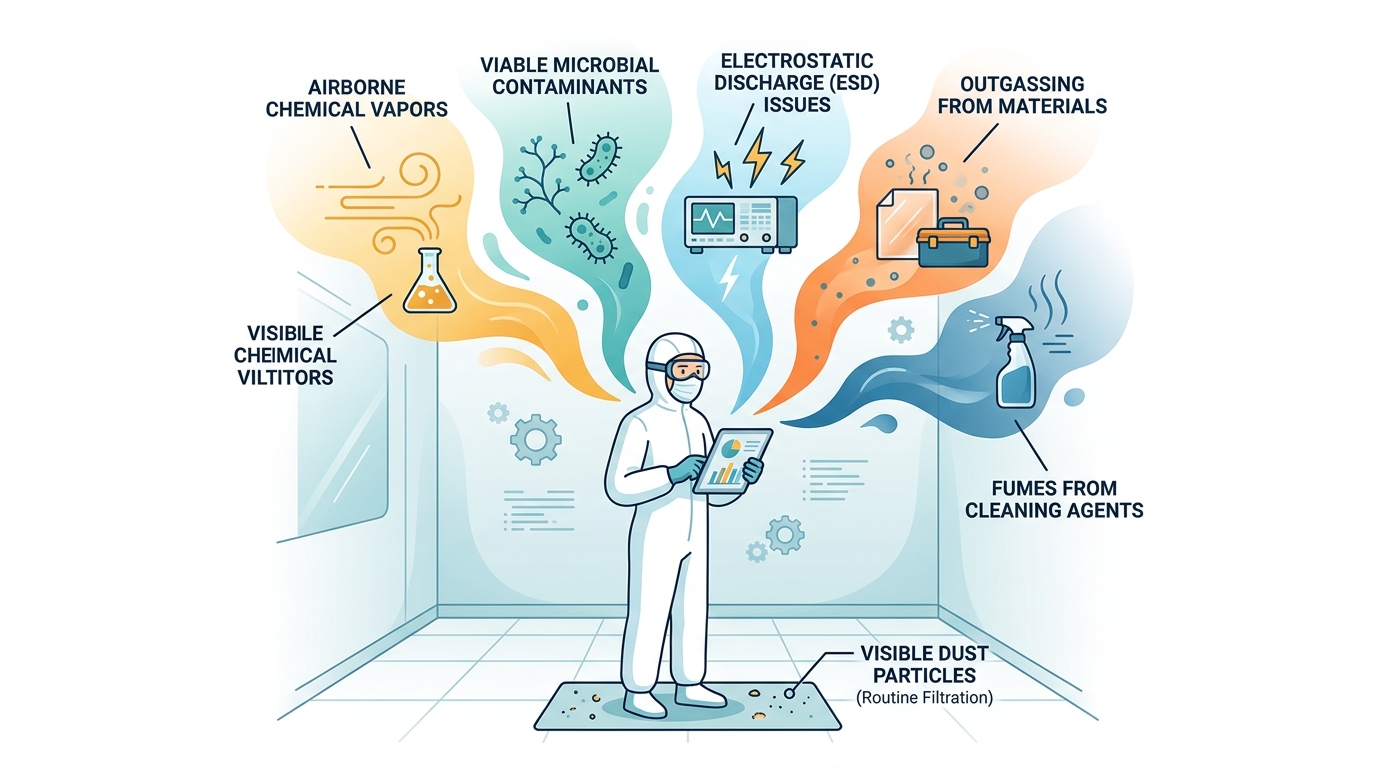
These controls become meaningful when they are connected to the actual process. Monitoring should answer a defined question, acceptance criteria should reflect a credible risk, and alarms should lead to an appropriate response. Maintenance, cleaning, staff behavior, and material transfers must support the same objectives rather than operate as disconnected procedures.
The most important distinction is between collecting evidence and demonstrating control. A normal reading is useful evidence, but its significance depends on what was measured, where and when it was measured, and which hazards remained outside the method's scope. A defensible contamination-control program combines complementary measurements with process knowledge, trend analysis, documented investigations, and periodic reassessment.
For laboratory managers and facility engineers, the practical goal is not to measure everything indiscriminately. It is to identify the hidden risks capable of changing a result, damaging a product, or undermining a critical operation, then apply controls that can detect and manage those risks. When invisible chemical contamination, microbial vectors, electrostatic discharge, and subtle pressure changes are treated as distinct but connected challenges, a cleanroom becomes more than a visually clean space: it becomes an environment whose performance can be evaluated, explained, and maintained.


Comments
Post a Comment